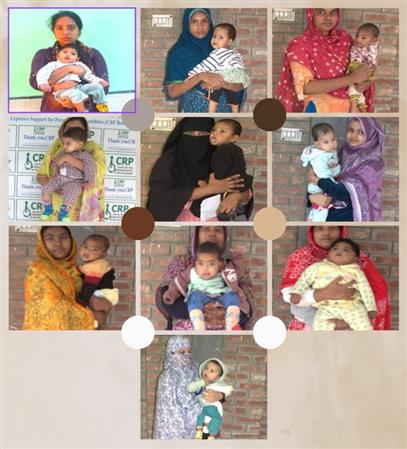
Early intervention can be life-changing for children with disabilities, especially those with physical challenges such as cerebral palsy.
Centre for the Rehabilitation of the Paralysed-CRP program supports children with cerebral palsy caused by brain injury before or shortly after birth. Very early intervention is critical and can make a lasting difference to both the children and their families.
Together, we are helping create better futures.
Click to view CRP Project details

Goals and provided treatment:
Provided Therapy | Long-Term Goals | Short Term Goals |
Physiotherapy, Occupational Therapy, Speech & Language Therapy | 1.The child will be able to engage in solitary play by changing position with minimum assistance within 8 months of therapy sessions. 2. The child will be able to have pre-verbal skills, receptive language skills & expressive language skills with 80% accuracy within 12 months in all environments. 3. The child will be able to sit independently within 8 months of therapy sessions.
| 1. The child will use gestures or vocalization to communicate basic needs during daily routines (feeding/play) with caregiver within 2 months. 2. The child will be able to rotate trunk to retrieve a toy placed behind midline and return to upright sitting independently within 12 weeks. 3. The child will transition from sitting to side-sitting or quadruped with minimal assistance within 10 weeks. 4. The child will be able to roll over with minimum assistance within 3 months. 5. The child will be able to sit from lying on bed with minimum assistance within 3 months. 6. The child will be able to manipulate toys by sitting with minimum assistance within 2 months. |
Provided Treatment Techniques and Approaches: Picture cards, Rhythmic musical rhymes, Van Riper Approach, positioning, transitional movement, stretching, strengthening exercise, engage in play at supported sitting position and vestibular stimulation, hand simulation tasks, bowel and bladder training, advice about safety issues.
 |  |  |
 |  |  |
 |  |  |
 |  |